

Content verified by

What are the different types of birth?
There are many things to think about when you’re pregnant and one of the most significant considerations is the type of delivery you choose.
This will usually be decided with the support of your midwife or doctor, as they’ll understand the needs of both you and your baby. However, it is important for you to discuss the different types of births there are, including the benefits and possible complications they are associated with.
At the Westminster Maternity Suite located in St Thomas’ Hospital, we’re here to offer expert-led births to support both mother and baby.
Experts in personalised maternity care
Our world-renowned maternity specialists offer:
- Short-notice appointments
- Spacious, en-suite rooms in the heart of London
- Expert care for high-risk pregnancies

There are several delivery types available, some of which may suit your needs better than others. By choosing us for your maternity and birth experience, we’ll give you all the information you need to make an informed decision that puts your safety and that of your baby first.
Vaginal birth
During a vaginal birth, your baby moves through the birth canal and out of your vagina. Our specialists may recommend this method of delivery because it carries the lowest possible risks.
The benefits of having a vaginal birth include:
- babies may have a more robust immune system
- babies may have a lower risk of respiratory problems
- faster recovery
- low risk of infection
Vaginal delivery typically occurs between weeks 37 and 42 of your pregnancy. It happens in 3 stages: labour, birth and delivering the placenta. While labour mainly occurs naturally, it can sometimes need to be medically induced in the hospital.
You can use pain relief during labour to keep your strength up for the delivery. We’ll talk you through your pain relief options beforehand, but you can also change your mind during labour if you wish.
Complications of vaginal birth
Sometimes a vaginal delivery can lead to complications, and you might need medical support to help your baby be born. For example, the baby can get stuck in the birth canal, or you might be unable to push them out if they’re a large baby.
If complications arise during vaginal delivery, you may need a:
- Caesarean section (C-section)
- forceps delivery
- vacuum delivery
Maternal risks may also occur in a vagina birth, such as:
- postpartum haemorrhage – you bleed heavily from your vagina due to the womb not contracting strongly enough, or due to parts of the placenta being left in the womb
- uterine rupture – where your uterus (also known as the womb) tears during labour
- endometritis – an inflammation of the womb’s lining
Our team will tell you what’s happening at every stage, so you know what’s going on and how we’re looking after both you and your baby.
If you’d like to explore which type of birth may be right for you, our maternity specialists can help guide your decision. Complete our online enquiry form to speak to our team.
Assisted vaginal birth
An assisted vaginal delivery is where we use forceps or a vacuum (suction cup) to deliver your baby. However, we only use these instruments when necessary.
If we need to assist with your baby’s delivery, we’ll give you a local anaesthetic to numb your vagina (if you’ve not already had an epidural). Then, we’ll cut the area between your vagina and anus (an episiotomy). Doing this helps to enlarge the opening of your vagina, making it easier for us to assist with forceps or a vacuum.
Forceps are a metal instrument that looks like two large spoons curved to fit around your baby’s head. While you push, we’ll use the forceps to guide your baby’s head out of your vagina gently.
A vacuum cup, or a ventouse, is a plastic or metal cup suctioned to your baby’s head. We’ll carefully pull on the vacuum cup during a contraction to guide your baby out.
Complications of assisted vaginal birth
An assisted vagina delivery is generally safe, but there are possible risks for mothers, such as:
- anal incontinence
- higher risk of blood clots
- urinary incontinence
- vaginal tearing
It also involves some risks for your baby, including:
- a mark or bruise on your baby’s head from the vacuum
- forceps marks on their face
- minor cuts on their face or scalp
- yellowing of the skin (jaundice)
If this occurs, it will usually heal quickly on its own within a few days, and we’ll care for your baby well throughout labour, birth and afterwards.
Fill in our online enquiry form to discuss your birthing options with our experienced maternity team at any stage of your pregnancy.
Caesarean section (C-section)
During a C-section, we deliver your baby through a cut in your abdomen and womb. C-sections can be planned (elective) or performed in emergencies.
Your midwife or doctor might recommend a C-section if:
- you are having a multiple birth
- your baby is breech (feet or bottom first)
- your baby is large
- you have previously had a C-section
They may perform an unplanned/emergency C-section if:
- labour isn’t progressing
- your baby is in distress
- you begin to haemorrhage
Our team will keep you up to date with what’s happening if you need an unplanned C-section, and will always ask for your consent before proceeding.
If you’re unsure which approach is right for you, complete our online enquiry form to arrange an appointment with our specialists who can offer personalised support and guidance.
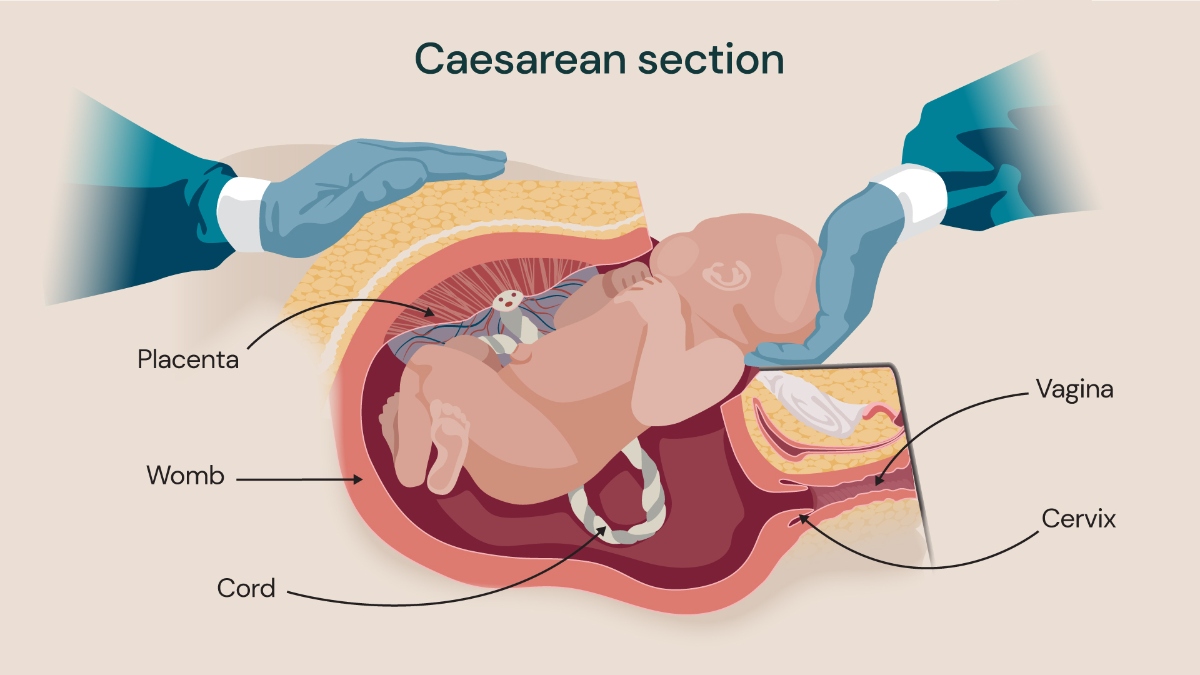
Illustration of a caesarean section (C-section), where a baby is delivered through a surgical incision in the abdomen and uterus, with key anatomical structures labelled.
Complications of a C-section
A C-section is a major surgery, so potential complications can occur.
Complications of a C-section may include:
- blood loss
- infection
- longer recovery and more time in the hospital
Although a C-section has an increased chance of complications, it’s a common surgery that many women undergo safely, and our specialists have preventative approaches to minimise any complications or risks.
Vaginal birth after caesarean (VBAC)
If you had a C-section previously, you may be able to deliver your next baby vaginally. However, a possible risk is that the scar on your womb from the previous C-section could tear during a vaginal delivery.
If you decide on a VBAC, there is certain criteria that minimises the risks involved.
This includes:
- the incision made previously is a low transverse incision (this is the usual incision doctors make during a C-section)
- you have no other uterine scars or abnormalities
- you haven’t had a uterine rupture before
If you’d like to explore your birth options, speak to our experience maternity team by completing our online enquiry form. Our specialists will explain the potential risks and help you decide if it suits you.
Complications of a VBAC
Although some women safely deliver their baby vaginally after a C-section, there is a higher risk of complications.
Complications of a VBAC can include:
- emergency C-section
- postpartum haemorrhage
- uterine rupture
Get expert support for your pregnancy
At Guy’s and St Thomas’ Specialist Care, we’re committed to your and your baby’s health. You can be confident when you choose our expert-led maternity team, and we’ll make sure you know what type of delivery is best-suited for you, before you go into labour.
If you have questions about your care or would like to discuss your symptoms, our experienced maternity specialists are here to help. Complete our online enquiry form or speak to our team to get the guidance and reassurance you need.
Reviewed regularly to reflect clinical best practice
Last reviewed: 08 April 2026
Related services
-
Maternity care
Our maternity specialists provide care for you and your baby throughout pregnancy and birth. We support vaginal, c-section and assisted deliveries, learn more.
-
Caesarean section (C-section)
A caesarean section, also known as a C-section, is a birth option for delivering your baby.
-
Labour and giving birth
Preparing for labour and birth is a vital part of pregnancy. Learn how Guy’s and St Thomas’ Specialist Care can help you get ready for your labour and birth experience.
-
Pain relief in labour
Our obstetric anaesthetists specialise in pain relief during labour including epidurals.
Locations
Our private maternity services are offered in the following locations:
Discover our supportive maternity care team