
Content verified by

What is peroral endoscopic myotomy (POEM)?
POEM is a minimally invasive procedure that treats swallowing disorders caused by oesophageal problems, bringing lasting relief by helping food pass through more easily.
We offer POEM procedures as part of our comprehensive gastrointestinal surgery services at St Thomas’ Hospital, where our gastroenterology and gastrointestinal specialists provide innovative treatments for a range of gastrointestinal conditions.
Experts in gastrointestinal care
Our specialists offer:
- short notice appointments, in as little as 24 hours
- fast and accurate diagnosis
- routine and complex gastrointestinal procedures

During a POEM procedure, our interventional endoscopist inserts an endoscope (a flexible tube with a camera on one end) through your mouth and into your oesophagus. This device enables us to cut the muscles in your oesophagus to loosen them and stop them from tightening, which is what prevents you from swallowing easily. The procedure also helps to alleviate uncomfortable symptoms that conditions like achalasia cause.
Achalasia is a condition which causes the muscles in your oesophagus to not contract or move food down properly to your stomach. It can cause symptoms like:
- bringing up food
- chest pain
- choking and coughing when eating
- recurrent chest infections
- gradual but unintentional weight loss
Why might a POEM procedure be performed?
Before POEM, you may be recommended to make lifestyle changes, take medications, or try Botox to relax your oesophageal muscle, as a form of treatment for achalasia. A POEM procedure may be the next option if all other treatments for your swallowing problems have failed.
Our team will discuss your current health, medical history and symptoms during a thorough consultation to ensure we provide the correct treatment for your needs.
Who is suitable for a POEM procedure?
A POEM procedure is most commonly used to treat achalasia, and our team of specialists typically offer it as a treatment option to patients aged under 75.
A POEM procedure may give you relief if your achalasia is causing significant symptoms like:
- a sore throat
- choking
- coughing
- food becoming trapped in your oesophagus
- weight loss or nutrient deficiencies
It can also help treat other conditions that affect your throat, such as spasms in your oesophagus, which aren’t responding to medication.
Before performing POEM, we’ll discuss your symptoms and current health with you to ensure this is the best procedure for your needs.
If you are experiencing any of these symptoms contact our team.
Preparing for a POEM procedure
Before your POEM procedure, you’ll have a pre-assessment appointment where we’ll ensure you’re well enough for general anaesthetic.
You must also follow a liquid diet for 3 days before your procedure to ensure your food pipe is empty. Sometimes, we’ll use a gastroscopy (where a thin, flexible tube is inserted down your throat) to wash out any remaining food.
What happens during a POEM procedure?
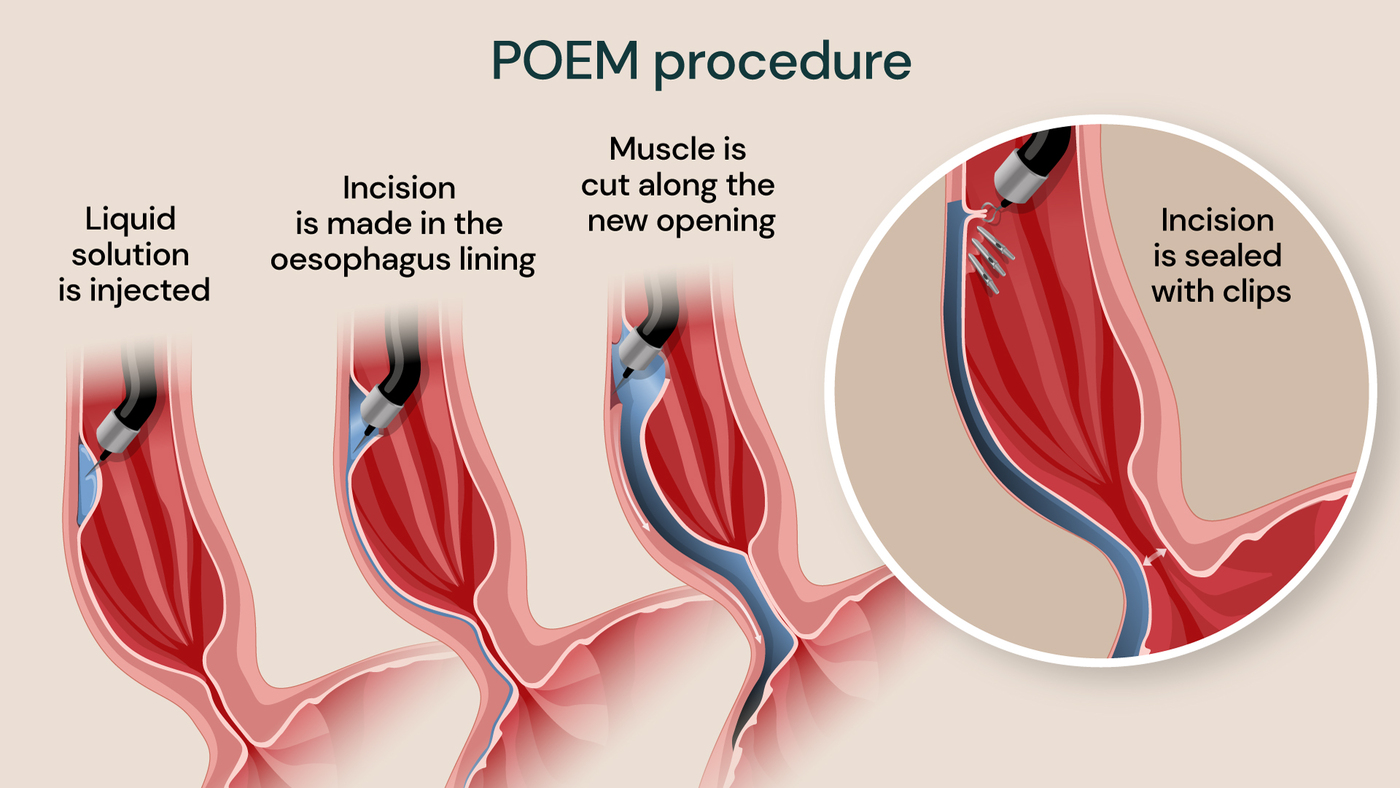
We perform your POEM procedure under general anaesthetic so that you will be asleep throughout. First, your consultant will pass an endoscope through your mouth and into your oesophagus. This then relays images of your oesophagus to the operating room.
Our interventional endoscopist will then insert surgical instruments through the endoscope and into your oesophagus so they can make a small cut in its lower lining. They will inject a liquid solution with a dye into this incision and separate the lining from the muscle. The dye helps our specialist to see the tissue planes in the muscle clearly.
A myotomy follows, where our consultant cuts the muscle along the newly created opening. Finally, they’ll seal the incision with tiny clips before removing the endoscope. The clips are biocompatible and remain in place while the muscle heals, before falling off naturally a few weeks after the procedure.
How long does a POEM procedure take?
A POEM procedure typically takes up to 2 hours to complete.
What happens after a POEM procedure?
After your procedure, we’ll take you to the recovery room. Once you come round from the anaesthetic, we’ll explain how the procedure went. You may need to spend up to 2 nights in the hospital for observation.
We’ll discuss when you can resume your regular diet and how to support your recovery at home.
What is the recovery time for POEM procedures?
Typically, your throat will feel sore after your POEM procedure. However, this should improve independently within a few days.
You must follow a liquid diet for the first week of recovery while your oesophagus heals.
It can take around 2 weeks to recover and resume your usual diet and activities.
To discover more about POEM or to make an appointment with our consultants, contact our team.
Benefits of a POEM procedure
A POEM procedure has many benefits, including:
- being less invasive than other treatments for swallowing problems
- effective results
- enhanced recovery
- long-lasting results
- no external scarring
- relief from your symptoms
This simple procedure helps many patients with swallowing problems, allowing you to return to your normal eating and drinking habits, unaffected by achalasia.
Risks of POEM
All surgical procedures carry potential risks, including a POEM procedure. However, while they can still occur, risks during a POEM procedure are uncommon.
Some of these possible risks include:
- bleeding or injury to your oesophagus
- collapsed lung (rare)
- gastro-oesophageal reflux disease (GORD)
- infection
- inflammation of your oesophagus
Our highly experienced gastroenterology team are experts at performing POEM procedures and will do everything they can to minimise the risks.
Alternative treatments
Alternative treatments to POEM can include dietary changes, since eating a diet that incorporates a soft food diet may make swallowing easier. However, this can make treatment challenging in the future, as continually eating soft foods can potentially stretch your food pipe.
If changing your diet doesn’t help, other surgeries like Heller’s myotomy, fundoplication and balloon dilation are minimally invasive procedures designed to significantly reduce acid reflux and other problematic oesophageal symptoms.
To find out which treatment is most suitable for you, speak to our customer service team.
Reviewed regularly to reflect clinical best practice
Last reviewed: 18 May 2026
Locations
Our gastrointestinal services are offered at the following locations:
Meet our team of expert gastrointestinal surgeons
Our dedicated gastrointestinal surgeons perform POEM procedures to treat swallowing disorders like achalasia.
Reviewed regularly to reflect clinical best practice
Last reviewed: 18 May 2026