

Content verified by

What is a caesarean section?
A caesarean section (C‑section) is a surgical procedure used to deliver your baby through an incision in your abdomen and womb. While many births happen vaginally, a caesarean section may be recommended or chosen when it is the safest option for you and your baby.
Caesarean sections can be planned (elective) or performed in an emergency, depending on your pregnancy and labour. Our maternity specialists provide personalised guidance to help you understand when a caesarean may be appropriate, how it compares to vaginal birth, and what to expect before, during and after the procedure.
At the Westminster Maternity Suite at St Thomas’ Hospital, we offer expert, consultant‑led care for caesarean birth as part of our private maternity services. Our experienced obstetric team supports you throughout pregnancy, delivery and recovery, ensuring you feel informed, confident and cared for at every stage.
Experts in caesarean birth
Our specialist maternity team provides safe, personalised care for caesarean delivery, including:
- individual birth plans, tailored to you and your baby
- expert, attentive care throughout pregnancy, delivery and recovery
- safe and supported caesarean birth, whether planned (elective) or in an emergency

Why would I need a caesarean section?
A C-section is a major operation, so it’s typically only offered if it is the safest option for delivery. However, you can choose to have a C-section if you do not wish to give birth vaginally once you have discussed the risks and benefits of the procedure.
Choosing to have a C-section as part of your birth plan is called an elective, or “planned”, C-section. Our obstetricians may also recommend a C-section if they think a vaginal birth is too risky for you and your baby.
You may also need a C-section despite choosing vaginal birth due to an emergency.
Our maternity specialists may recommend a C-section if:
- your baby is in the breech position (feet down, head up) and they haven’t turned even when a doctor or midwife applies gentle pressure to your tummy
- you have a low-lying placenta
- you have pre-eclampsia (pregnancy related high blood pressure)
- you have an infection that you can pass to your baby during vaginal birth, such as untreated HIV
- you are experiencing excessive vaginal bleeding
- your labour is not progressing correctly or if the baby is showing signs of distress (risking you and your baby)
You can have a C-section even if you do not have any medical reasons for doing so. Some women choose the procedure because they have severe anxiety about vaginal births. Although vaginal births are natural, feeling nervous about them is normal and a valid reason to request a C-section.
Is an elective caesarean section right for me?
Our maternity specialists are here to support you in making an informed decision about birth options, providing personalised guidance based on your health, pregnancy and preferences. We take the time to explain when a caesarean section may be recommended to support the safety of you and your baby, as well as when it may be an option by choice.
As part of your care, our team will talk you through the benefits, considerations and recovery involved, helping you understand how caesarean birth compares to other options. If you are exploring your choices, you can also learn more about the different types of birth available and how they may apply to your pregnancy.
Where appropriate, our specialists will work with you to develop a personalised birth plan, ensuring you feel supported and reassured, whether you are planning a caesarean section or considering alternative approaches.
Make an online enquiry to speak to our maternity specialists, who can guide you in deciding whether a caesarean section is suitable for you.
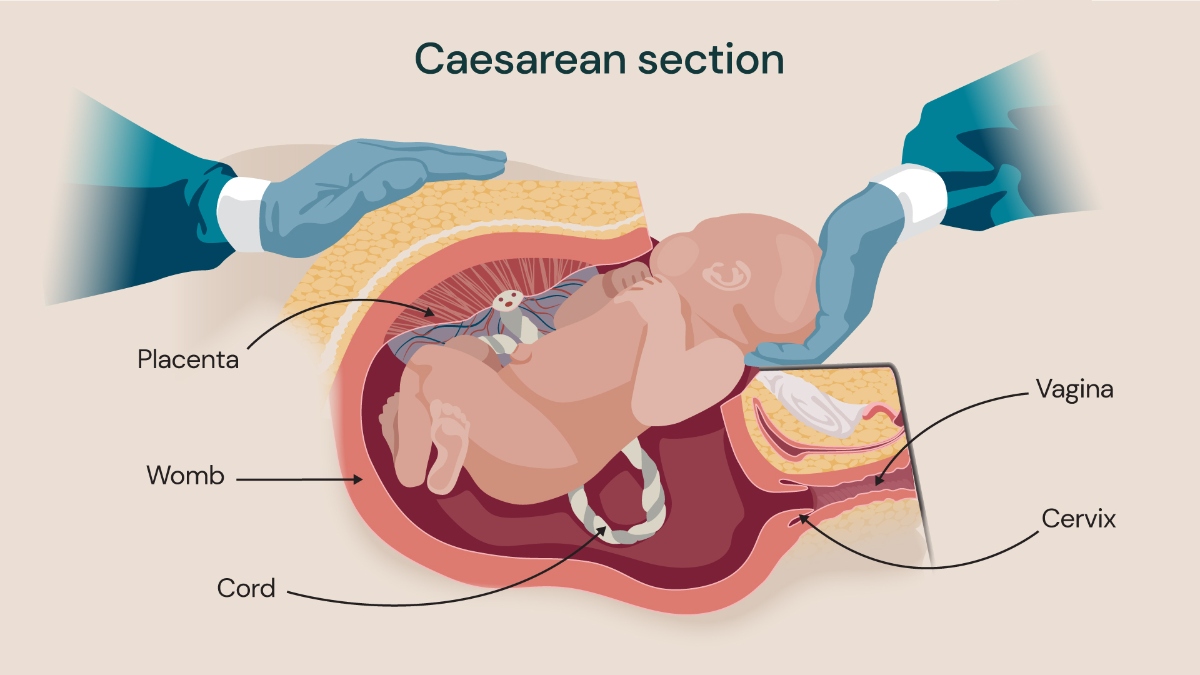
Illustration of a caesarean section (C-section), where a baby is delivered through a surgical incision in the abdomen and uterus, with key anatomical structures labelled.
What happens during a caesarean section?
Before your C-section begins, an anaesthetist will give you a spinal or epidural anaesthetic. So, you will be awake during your baby’s birth but won’t feel anything in your body’s lower part.
One of the medical team will place a screen across your body to stop you from seeing the operation. The surgeon will make an incision between 10cm and 20cm long along your lower stomach, giving them access to your womb. You won’t feel any pain during a C-section, but you may feel some pulling or tugging while the surgeon delivers your baby.
You can see and hold your baby immediately after delivery. This might only be possible if there aren’t any complications with you or your baby. If you have had an emergency C-section due to fetal distress, your baby must be checked and medically cared for before you can hold it.
How long does a caesarean section take?
A C-section usually takes between 40 and 50 minutes to complete. The time will vary depending on any complications that arise, but our surgeon will do their best to deliver your baby as quickly and safely as possible.
How long does it take to recover from a caesarean section?
After your C-section, you must stay in the hospital for one or two days so our specialists can monitor you and your baby. While in the hospital, we will give you pain relief medication to reduce your discomfort. You can also have close contact with your baby and breastfeed.
A catheter will help you empty your bladder for the first 12 hours after your C-section and we’ll cover your wounds with a dressing for at least 24 hours. You should be able to eat and drink after your C-section when you feel hungry or thirsty. You can expect vaginal bleeding during your recovery, but this is normal after any birth.
You cannot drive for a few weeks, so you must ensure somebody is available to take you and your baby home. You won’t be able to carry anything heavier than your baby for the first six weeks or so of your recovery. Similarly, you must avoid exercising and sex.
Full recovery from a C-section can take up to six weeks, but everyone is different. Your body will heal at the rate that’s right for you.
Complete our online enquiry form to request an appointment with our specialists, who can answer your questions about caesarean section, including the procedure and recovery.
Benefits of a caesarean section
The benefits of a C-section will vary depending on your reason for having one. One of the main advantages is that doctors can perform a C-section in an emergency to deliver your baby safely. Another benefit is its use in cases where vaginal delivery is unsafe for you or your baby.
Choosing a caesarean section can be beneficial for planning reasons. With an elective C-section, you’ll know your baby’s exact birth date — allowing you to plan your new routine around it. It can also make it easier for you to prepare your home because you’ll know the day you’ll be returning with your baby.
Risks of a caesarean section
Caesarean sections are a major surgery but are generally very safe. However, they have some risks that can affect you and your baby.
The risks of a C-section to you include:
- wound infection
- infection of your womb lining
- blood clots (deep vein thrombosis)
- excessive bleeding
- damage to your bladder or the tubes connecting your bladder to your kidneys
We’ll give you antibiotics before your C-section to help reduce the risk of infection.
The risks of a C-section to your baby include:
- temporary breathing difficulties (this usually affects babies born before 39 weeks and improves within a few days)
- minor cuts to the skin
Risks to future pregnancies
C-sections do not cause problems if you become pregnant again. Most women who have a C-section with one pregnancy can still give birth vaginally — known as vaginal birth after caesarean (VBAC).
However, you might need a C-section in your subsequent pregnancy if there is a risk of the scar in your womb opening or your placenta attaching to the womb’s wall.
Speak to our maternity specialists
If you would like expert advice or support planning your care, our experienced maternity team is here to help. We offer personalised, consultant‑led support to ensure you feel informed, confident and cared for at every stage of your pregnancy.
Complete our online enquiry form to request an appointment and speak to a specialist at the Westminster Maternity Suite at St Thomas’ Hospital.
Reviewed regularly to reflect clinical best practice
Last reviewed: 01 March 2024
Locations
Our maternity care services are available in the following locations:
Discover our maternity experts