
Authors

Our paediatric cardiology specialists provide advanced diagnosis and treatment for congenital and acquired heart conditions, from before birth through to adulthood.
Workings across Evelina London Children’s Hospital and Royal Brompton Hospital, our multidisciplinary team delivers innovative, research led care for complex cases.
To discuss a patient or refer a case, complete our online enquiry form.
Why children with complex heart conditions need specialist paediatric cardiology care
Children may experience a range of heart problems, including congenital heart disease (present from birth), acquired heart disease (developing after birth), and heart rhythm disturbances. While some conditions like heart murmurs may resolve over time, others can be complex and affect multiple organs.
Specialist multidisciplinary care is often required, particularly for complex congenital heart conditions. Our paediatric cardiology service brings together expertise across imaging, surgery and specialist support services to provide comprehensive care.
Conditions we commonly diagnose and treat
Our paediatric cardiology specialists have expertise in diagnosing and treating a range of conditions, including:
- congenital heart disease
- acquired paediatric heart disease
- heart rhythm disturbances
Why multidisciplinary care matters
Many children with congenital heart disease require input from multiple specialists. For example, 1 in 4 children with congenital heart disease also have a problem with another organ or system in their body. They may require additional specialist support in areas such as gastroenterology, nephrology and neurology.
Access to a specialist centre ensures coordinated, expert-led care.
Diagnostic imaging and innovation in fetal cardiology
Our paediatric cardiology specialists use advanced imaging technologies to improve the early diagnosis and treatment planning of congenital heart disease.
Evelina London Children’s Hospital has the largest and longest established fetal cardiac service in the UK, overseeing 2,000 pregnancies a year for the diagnosis of congenital heart disease.
3D MRI for fetal congenital heart disease diagnosis
Our team has developed a world-first approach to 3D MRI scanning, improving the ability to diagnose congenital heart disease in unborn babies. This builds on earlier advances in fetal cardiac MRI, supporting more accurate and earlier diagnosis.
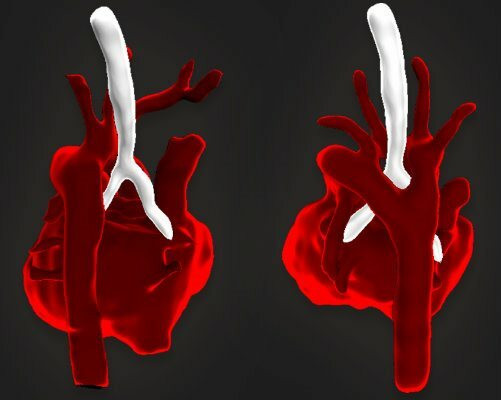
Three‑dimensional illustration of fetal heart anatomy, showing the structure of the heart and major blood vessels before birth.
With the close academic partnership between Evelina London clinicians and the biomedical engineering scientists at King’s College London, our team is at the forefront of research into fetal and paediatric cardiac diagnostic imaging.
Through this partnership, the team have jointly developed a world-first method to conduct 3D MRI scans, improving diagnosis in babies while still in the womb. This builds on the team’s work conducting the world’s first ever fetal cardiac MRI scan – read more about our 3D fetal cardiac imaging technology.
This approach uses novel computing technology to correct for movement in fast-moving unborn babies, overcoming limitations of standard ultrasound imaging used in other centres.
“Congenital heart diseases cause structural problems with the heart that may require surgical intervention soon after birth, often within the first week of life,” explains Dr Owen Miller, our consultant in paediatric and fetal cardiology at Evelina London Children’s Hospital.
“It is therefore important to precisely diagnose the type of congenital heart disease in the unborn baby during pregnancy to ensure we can prepare for surgery soon after delivery and achieve the best outcomes.”
Virtual reality planning for complex cardiac surgery
Our cardiac surgeons use virtual reality technology to create immersive 3D models of a patient’s heart. This supports surgical planning, helping determine whether surgery or minimally invasive procedures are most appropriate.
This approach enables surgeons to plan operations in detail and select the most effective intervention, improving outcomes for children with complex congenital heart conditions.
Read more about our work in fetal cardiology in our innovations in fetal cardiology article.
Clinical research and publications
Our specialists contribute to leading research in paediatric cardiology, including advances in imaging and surgical planning:
- Virtual reality echocardiographic imaging for surgical atrioventricular valve repair – View publication on PubMed
- Virtual reality planning for covered stent correction of sinus venosus atrial septal defects – View publication on PubMed
- Extended reality for planning and guidance in structural heart disease – View publication on PubMed
To discuss your patient or refer a case to our paediatric cardiology team, complete our online enquiry form.
Early diagnosis using advanced fetal ultrasound
Using high-resolution ultrasound scanners at our fetal cardiology unit, our specialists can detect congenital heart defects in unborn babies from as early as 12 weeks of pregnancy, instead of the routine 20-week scan.
Find out more about our fetal cardiology imaging at Evelina London Children’s Hospital.
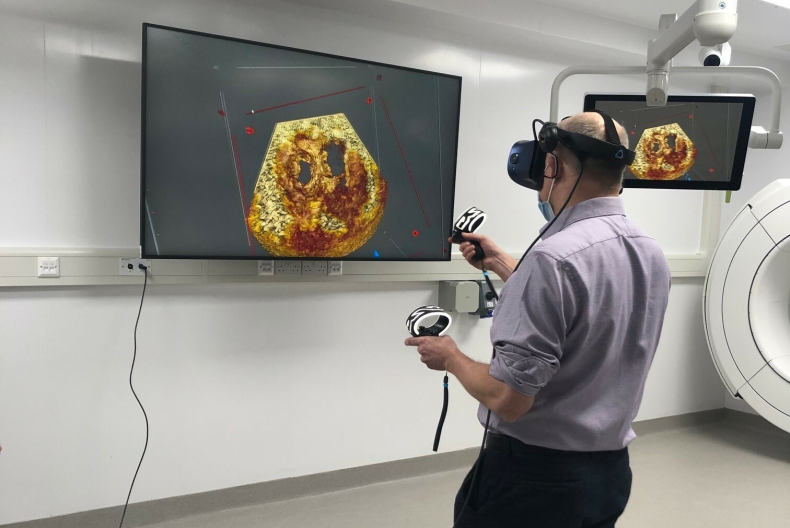
Professor John Simpson using virtual reality technology at Evelina London Children’s Hospital to explore three‑dimensional cardiac imaging.
Advancing prenatal imaging through artificial intelligence
Our fetal cardiology team is also developing artificial intelligence tools to support prenatal cardiac imaging. These approaches have been shown to reduce the time required to obtain detailed fetal cardiac scans, improving efficiency and diagnostic accuracy.
Clinical research
- AI to assist in the fetal anomaly ultrasound scan – View publication in NEJM AI
Coordinated specialist care from diagnosis to treatment
As specialist maternity and paediatric cardiac services are co-located on site, babies diagnosed with heart defects before birth can:
- be delivered in a specialist centre
- transfer directly to cardiac surgery shortly after birth
- receive coordinated multidiciplinary follow-up care in one location
To discuss a patient or refer a case to our fetal cardiology team, complete our online enquiry form.
A history of world-first heart procedures
Both Royal Brompton and Evelina London Children’s hospitals have a long history of pioneering heart procedures that improve the health of patients with congenital heart disease.
Between our hospitals, we have performed many world-firsts, including the first:
- autograft aortic valve replacement (Ross operation)
- fetal cardiac intervention
- MRI-guided cardiac catheter procedure
- PEARS procedure
- radiofrequency perforation of pulmonary valve
- Ross-PEARS combined procedure
We also have world-renowned expertise in transcatheter interventions, including:
- closure of complex atrial septal defects
- closure of patent ductus arteriosus
- closure of peri-membranous ventricular septal defect
- closure of sinus venosus defects
- implantation of the Venus P -Valve in the pulmonary position
With our combined expertise in cardiac surgery and imaging across Royal Brompton and Evelina London Children’s hospitals, we offer procedures that treat the most complex forms of congenital heart disease from before birth and through to adulthood.
Our cardiac specialists are some of the only UK surgeons performing the Nikaidoh and double root translocation procedures for complex conotruncal anomalies. Our hospitals have achieved outstanding outcomes in all aspects of paediatric cardiac surgery, including the Norwood open-heart operation for hypoplastic left heart syndrome.
In addition to surgical procedures to treat structural problems of the heart, our consultant cardiologists and electrophysiologists are experts in minimally invasive procedures to correct heart rhythm disturbances, including cardiac ablation.
Personalised life-long care for every patient
“Treatments for congenital heart disease have improved greatly in recent decades as we continue to advance care. Recent data suggest that over 97% of children born with congenital heart disease now survive into adulthood, which is a tremendous achievement,” says Professor Alain Fraisse, consultant paediatric cardiologist at Royal Brompton Hospital.
“Adults with congenital heart disease (ACHD) often have complex health needs and require lifelong specialist monitoring and care. Guy’s and St Thomas’, across the Royal Brompton and St Thomas’ sites, is the largest centre for congenital heart disease in the UK, with the expertise to manage even the most complex cardiac conditions.”
Following a successful pilot in 2020, both Royal Brompton and St Thomas’ Hospitals now offer a one-stop adult congenital heart disease (ACHD) service where patients can receive all their routine monitoring diagnostic tests and see their consultant cardiologist and specialist cardiology nurse all on the same day.
“Our ACHD service greatly improves the care offered to our patients. Rather than waiting for multiple diagnostic tests that are sometimes arranged months apart on the NHS, they receive a convenient one-day service designed around them with minimal impact to their routine,” explains Professor Michael Gatzoulis, consultant cardiologist in congenital heart disease at Royal Brompton Hospital, who led the development of the service. Find out more about our ACHD service here.
Many of our cardiologists have academic posts with our university partners Imperial College London and Kings College London, ensuring paediatric and adult congenital heart disease services across all our hospitals benefit from the cutting-edge research at two of the world’s top universities.
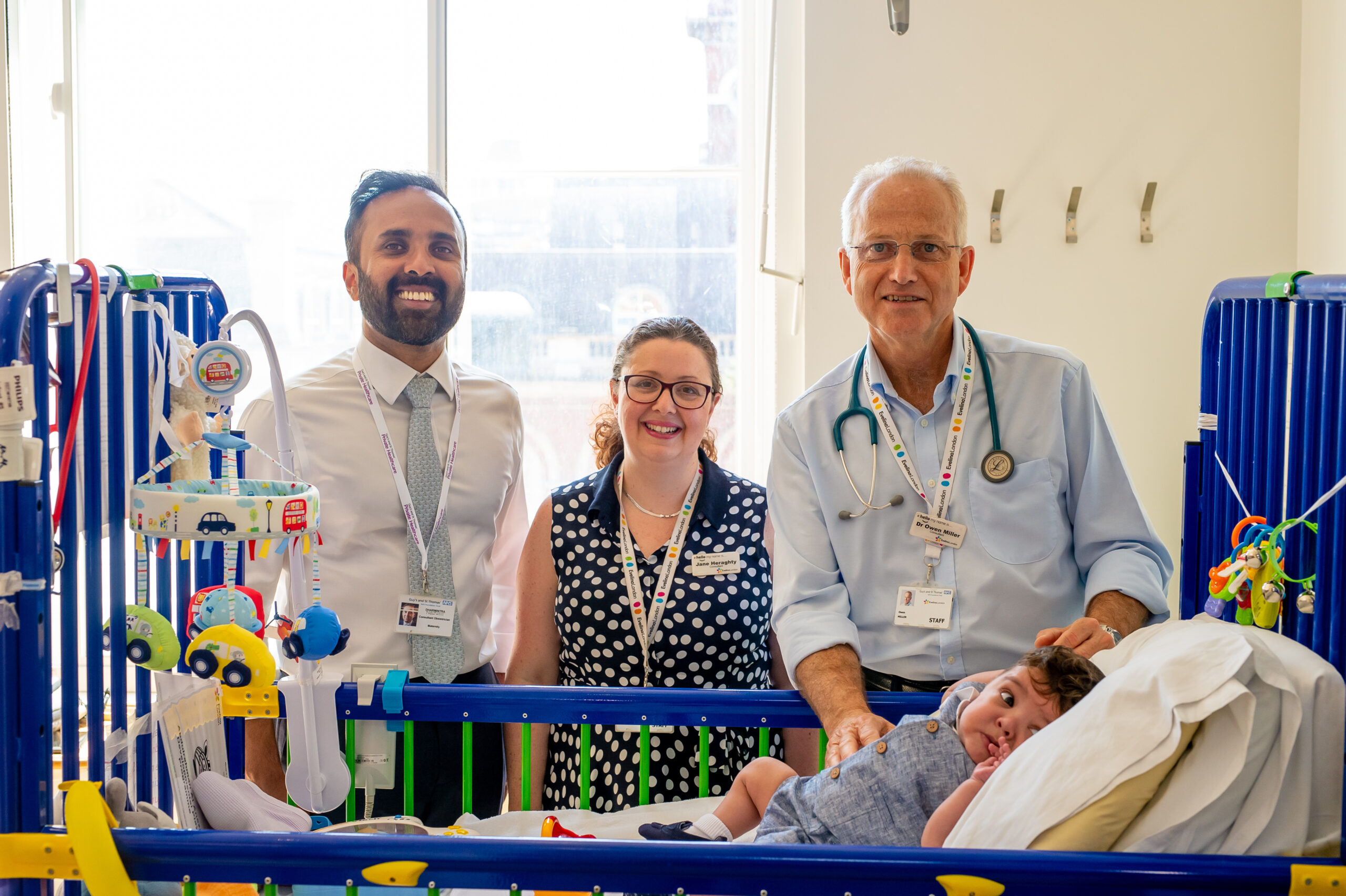
Specialist clinicians providing neonatal care at Evelina London Children’s Hospital, supporting babies and families in a clinical ward environment.
A paediatric cardiology case like no other
Our international paediatric patient Abdulrahman from Kuwait was nicknamed ‘the little survivor’ by our team at Evelina London, as his fight for life began before he was even born.
He was diagnosed with the rare congenital heart disease hypoplastic left heart syndrome by Dr Owen Miller while still in his mother’s womb, which would require surgical intervention soon after birth.
After his delivery at St Thomas’ hospital, our consultants conducted surgical procedures – including the complex Norwood procedure – to treat his heart condition.
However, soon after surgery and while in our paediatric intensive care unit, he was starting to get very unwell and not putting on the weight he should.
After conducting a range of tests on his lungs, our paediatric respiratory specialists discovered he had primary ciliary dyskinesia, an extremely rare lung condition that prevents his lungs from effectively clearing mucus in its linings, among other organ complications.
The combination of these rare conditions in one patient is believed to be the first in the UK.
Thankfully, with our comprehensive multidisciplinary expertise on one site at Evelina London Children’s Hospital across cardiology, surgery, respiratory and intensive care, Abdulrahman’s condition improved, and he was able to make it home to his loving family where he continued his treatment.
Abdulrahman will need continued monitoring and likely further surgery on his heart at our hospitals in future but will be in the safest hands with our consultants.
Refer a patient or speak to our paediatric cardiology team
Our paediatric cardiology specialists provide expert care for congenital and acquired heart conditions, from fetal diagnosis through to adulthood.
To refer a patient or discuss a case with our team, complete our online enquiry form.
Reviewed regularly to reflect clinical best practice
Last reviewed: 03 December 2025
We provide specialist diagnosis, imaging and treatment for congenital heart disease across all stages of life.
-
Children’s cardiac surgery
Children's cardiac surgery is used to treat a range of congenital heart issues such as damaged valves, blood clots and blocked arteries.
-
Congenital heart disease
Congenital heart disease is a collective term for a range of birth defects that affect the heart. Learn more about how it is diagnosed and treated.
-
Fetal cardiology
As one of the largest fetal cardiology units in Europe we manage heart problems in babies before birth.