
Content verified by


What is a tongue-tie?
Tongue-tie (ankyloglossia) is a condition that is present at birth and affects the tongue and restricts its movement. This can have an impact on feeding, particularly in the newborn period.
Tongue-tie is usually diagnosed and treated during early infancy, but it can be diagnosed in adulthood. The condition does not always require treatment – your child can have a tongue-tie and not experience any problems.
At Evelina London Children’s Hospital, our specialists offer diagnosis and treatment of a tongue-tie to provide relief from this sometimes problematic condition. We offer a same-day ‘see and treat’ service for infants less than 3 months of age, so that breast or formula feeding can continue without disruption.
Experts in treating tongue-tie in children
Our world-leading children’s consultants offer:
- short-notice appointments
- fast and accurate diagnosis
- minimally invasive treatment for tongue-tie on the same day as your consultation

Signs of a tongue-tie
If your child has tongue-tie, the band of tissue (frenulum) that connects the bottom of their tongue to the floor of their mouth is shorter and thicker than it should be. It can also be too tight.
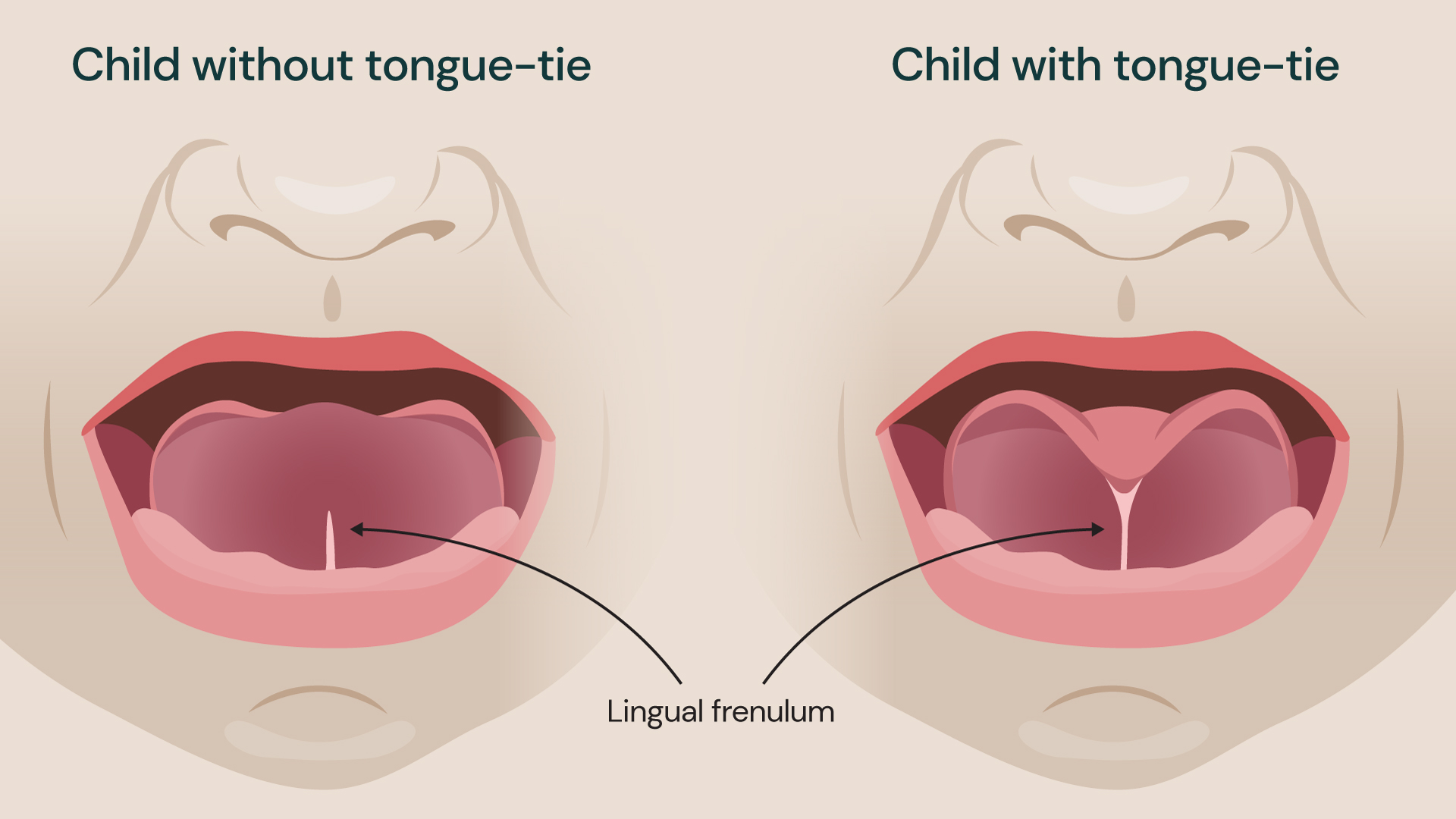
Tongue-tie, also known as lingual frenulum, restricts movement in the mouth
The most common type of tongue-tie develops at the front of the tongue or the anterior frenulum. However, tongue-tie underneath and at the back of the tongue (posterior tongue-tie) is also possible.
Your baby or child may not experience any complications with tongue-tie if it is not severe. However, some signs that they may have tongue-tie include:
- difficulties breastfeeding with a poor latch
- difficulty sticking the tongue out
- problems lifting the tongue to the roof of their mouth and side-to-side
- speech issues when pronouncing letters such as ‘t’, ‘d’, ‘l’ and ‘th’
- a lisp
- a notched or heart-shaped tongue when stuck out
Babies may have difficulties feeding with a tongue-tie. They may be unable to successfully latch when feeding, due to the poor range of motion. This prevents the mouth from sealing when babies express milk from a bottle or your nipple.
If you’re concerned about your baby’s feeding and think it may be due to tongue-tie, our consultants can help. Complete our online enquiry form and a member of our team will be in touch.
Tongue-tie symptoms
The symptoms of tongue-tie can vary depending on age. Symptoms of tongue-tie in babies are not just limited to problems when latching. They can also experience hunger and difficulty gaining weight due to their inability to feed correctly. You may also hear a clicking noise when they feed.
If you are breastfeeding and your child has a tongue-tie, you might develop sore nipples and pain during feeding and a low milk supply.
Symptoms of a tongue-tie in younger children are:
- speech difficulties
- swallowing problems
- struggling to play wind instruments
- issues when sticking their tongue out and up
Tongue-tie causes
Tongue-tie occurs during fetal development. Typically, the tongue and floor of the mouth will fuse and then separate while in the womb. This separation and fusing leaves a thin band of tissue connecting the tongue to the mouth. However, in the case of tongue-tie, this band remains thick.
The reason for tongue-tie development is not entirely known or understood. Experts think it’s genetic, with tongue-ties seemingly running in families. They are more common in boys, but again, no one is certain why.
Tongue-tie diagnosis
Tongue-tie is sometimes diagnosed during a baby’s newborn examination. However, it is not always easy to spot.
If you notice that your baby is having problems feeding, you can speak to our specialists for a formal diagnosis. They will carry out a physical examination to see if your baby has tongue-tie by assessing the tongue’s movement and range of motion.
If you suspect your child may have tongue-tie, complete our online enquiry form to book an appointment with one of our specialists.
Tongue-tie treatment
Tongue-ties do not always require treatment. However, if your baby is struggling to feed, they are likely to benefit from an assessment and division.
Tongue-tie division (frenotomy)
This procedure involves cutting the connecting frenulum underneath the tongue to improve its mobility. Your surgeon will use sterile scissors to perform a tongue-tie division either with or without anaesthetic. Tongue-tie division is almost painless and over quickly.
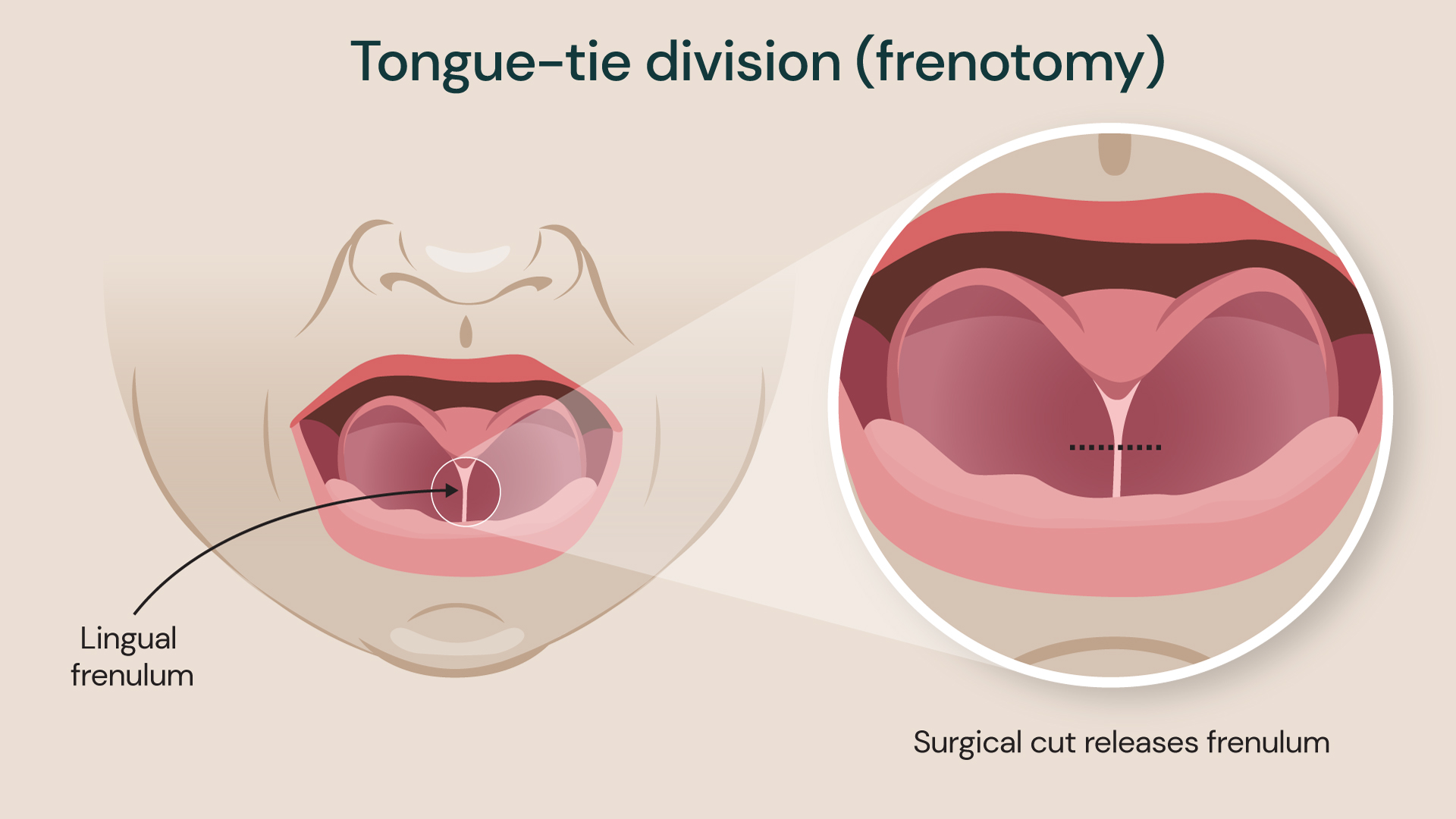
Surgical treatment for tongue-tie also known as frenotomy
Tongue-tie anaesthesia
In babies, doctors usually do not use anaesthetic. In older children they will likely need a general anaesthetic to divide it.
The procedure does not seem to hurt young babies. This is because there are very few nerve endings in that area of their mouth.
Older babies and children will usually undergo the frenotomy with a general anaesthetic so that they will be asleep during it and remain still, which is paramount for their safety.
The procedure only takes a few minutes and does not cause much bleeding. Complications of tongue-tie division are rare. However, the frenulum can rarely reattach itself to the base of the tongue over time.
Complementary treatments
As well as tongue-tie division, other accompanying treatments can help. A speech and language therapist can be useful if your child has speech problems caused by a tongue-tie.
If you are breastfeeding a baby with a tongue-tie, our multidisciplinary team of baby specialists can advise on lactation, nutrition and diet – complete our online enquiry form to get in touch.
Discover our tongue-tie experts
Tongue-tie is not often a debilitating health condition. However, that does not mean it can’t cause problems for your child. We provide easy, safe ways to treat tongue-tie and relieve any symptoms they may be experiencing at Evelina London Children’s Hospital.
Complete our online enquiry form to book your child’s consultation today.
Reviewed regularly to reflect clinical best practice
Last reviewed: 13 December 2024
Locations
Our children's services are located at:
Discover our tongue-tie experts
Tongue-tie is not often a debilitating health condition. However, that does not mean it can’t cause problems for your child. We provide easy, safe ways to treat tongue-tie and relieve any symptoms they may be experiencing at Evelina London Children’s Hospital.
Our consultants are highly skilled in performing tongue-tie divisions in babies and children so you can rest assured that your child is in the safest hands.